Product Overview
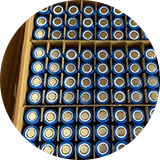
This cell is a 3.2V 14500 LiFePO4 battery rated 600mAh, built with a raised button top and measuring 14.2 mm across the can and 50.5 mm at most in height. The model is LF14500-600, the size we supply for solar lawn lighting and other compact outdoor devices that need a small, long-life power source. It is a single cylindrical cell rather than a finished pack, so it seats directly in a holder or a welded battery bay. The button top is the reason this version exists. Lawn lights, path lights and stake lights usually hold the cell between a spring at the negative end and a fixed contact at the positive end, and that contact needs the raised cap to press against. A flat-top cell in the same bay can sit loose, arc, or read as a dead battery after a season outdoors. Nominal voltage is 3.2V, the level a LiFePO4 cell holds across most of its discharge curve, so the lamp's driver and charge circuit have to be designed for that chemistry. Treat this as a rechargeable lithium battery for 3.2V circuits rather than a 1.5V alkaline AA substitute, even though the can sits in a similar holder. In a light that charges by day and runs at night, that is the difference between a cell fitted once at the factory and a cell someone has to reopen a sealed head to replace. Most of this size goes to lighting manufacturers and assemblers building lawn, garden and path lights, and to distributors and repair shops keeping the size in stock. Tell us the fixture, the holder and the volume, and we will confirm the configuration that suits it.
Key Features
- Stable iron-phosphate chemistry. LiFePO4 is one of the more thermally forgiving lithium chemistries, which matters in a lamp head that sits in direct sun all day and is sealed against rain. Matched capacity, voltage and resistance. Cells are graded so neighbouring cells sit close together, which keeps a two- or three-cell lamp from being limited by its weakest cell.
Certificates and Test Documentation
| Safety certification | CE, CB and IEC62133 |
| Additional safety certificates | UL and PSE |
| Restricted substances | RoHS |
| Chemical compliance | REACH |
| Quality management system | ISO9001 |
| Environmental management | ISO14001 |
| Social compliance audit | BSCI |
| Transport testing | UN38.3 |
| Transport paperwork | MSDS plus air and sea transport identification and classification report |
| Cell-level cycle testing | Every cell is cycled three times before it leaves the line |
| Outgoing inspection | 100% check on appearance, voltage, capacity, resistance and dimensions |
| Certificate scope | Confirm the exact certificate numbers and issuing bodies you need for your market before ordering |
Fitting and First Charge
- Measure the battery bay against the maximum figures: 14.2 mm diameter and 50.5 mm height, with enough room for the spring to compress without flattening the button.
- Check that the positive contact presses on the raised cap. If the holder was designed around a flat-top cell or a welded tab, raise it with us before you order rather than bending the contact to fit.
- Confirm the lamp's charge circuit stops at 3.65 V and its discharge cut-off sits at 2.3 V. Those two numbers are what protect the cell in a fixture nobody opens.
- Charge through a CC/CV lithium battery charger set for a 3.2V cell. A charger built for 3.7V Li-ion cells pushes to 4.2 V and will overcharge this chemistry.
- Set the current to 0.2C, which works out at about 120 mA for a 600mAh cell. 1C (600 mA) is the maximum continuous rate and 3C is for short pulses only.
- Run a first charge and check the numbers before the unit is sealed: the charger should terminate cleanly at 3.65 V and the cell should hold its voltage after a short rest.
Operating and Storage Window
Charging is rated from 0 °C to 45 °C and discharging from -20 °C to 60 °C. In a lamp, that means the controller should hold off charging on freezing nights and pick up again once the head warms, while the light itself keeps running down to -20 °C.
Storage follows a sliding scale: up to 12 months between -20 °C and 25 °C, up to 3 months between -20 °C and 35 °C, and up to 1 month between -20 °C and 45 °C. Stock kept in the coolest, driest part of the warehouse stays inside the longest window.
Leave cells in their original packaging until they reach the line. The sleeve and the button decide whether a cell seats properly, and loose cells in a parts bin collect the kind of knocks that turn into a contact fault later.
Heat is what shortens service life, so a head that traps air around the battery bay in summer will age the cell faster than a design with a little ventilation, even though both use the same rechargeable lithium battery inside.
For storage longer than a few months, keep the cells at a partial charge rather than full and give the stock a top-up before it goes into production. It is the same housekeeping any lithium cell needs, and it costs a few minutes per carton.
Where the Cell Is Used
- Solar lawn and path lights. Stake lights, bollard lights and garden lanterns running a single cell through a 3.2V controller, where 600mAh covers the overnight run and recharges on the next day's sun.
- Decorative solar string and garden lighting. Small boards driving a few LEDs at low current, where a compact LiFePO4 battery keeps the housing short enough to tuck behind a panel.
- Small solar wall and yard lights. Single-cell drivers in low-wattage fixtures, matched with a charge circuit that stops at 3.65 V.
- Miner's lamps and emergency lights. Handheld and wall-mounted units whose small LED drivers expect a 3.2V source with a long cycle life rather than high current.
- Backup and hold-up power for compact devices. Control boards and small instruments that need a dependable 3.2V cell in a can no bigger than an AA.
- Replacement stock for repair work. Shops that refurbish garden lights keep this size on the shelf so one tired cell does not scrap an otherwise sound fixture.
Specifications
| Nominal Voltage | 3.2V |
| Nominal Capacity | 600mAh at 0.2C discharge |
| Max Dimensions | 14.2 mm diameter × 50.5 mm height |
| Cycle Life | ≥2000 cycles, ≥80% of nominal capacity |
| Charge Method | CC/CV with a lithium battery special charger |
| Charge Cut-off Voltage | 3.65V |
| Discharge Cut-off Voltage | 2.3V |
| Standard Charge Current | 0.2C |
| Standard Discharge Current | 0.2C |
| Max Continuous Charge Current | 1C |
| Continuous Discharge Current | 1C |
| Peak Discharge Current | 3C |
| Internal Resistance | ≤50 mΩ |
| Weight | Approx. 16 g |
Ordering and Delivery
- Send the application first: the fixture the cell goes into, the holder or bay drawing, and how many cells each unit takes.
- Tell us the terminal arrangement your build needs. The button top is the standard configuration; if your holder or board calls for a different contact, that becomes a custom lithium battery project, and we will confirm what is achievable before quoting.
- Confirm the quantity for the first run and the likely annual volume. Volume is what decides the price break and the production slot, so it is worth settling early.
- Agree the documentation that has to travel with the order, and check that the model and date on each certificate match the cells you are buying.
- Confirm lead time, packing format and the shipping documents your forwarder needs before you book freight — the paperwork is usually what holds a shipment up, not the cells.
- Ask for the warranty and after-sales terms that apply to your order and keep them with the order confirmation.
Scale & Supply Capability
Topwell Power is a lithium battery manufacturer, not a trading house. Our range runs from compact packs to large storage systems, so buyers can consolidate several lines behind one specification standard and one set of shipping documents. OEM and private-label work is routine: your label, case marking, terminal choice, capacity and packing configuration. Capacities and enclosures are customised per project, samples are available before a production run, and shipments go out with the transport documentation freight forwarders ask for. Send your target specification and volume, and we will confirm lead time, packing and pricing for that order.
FAQ
Will this cell replace the AA alkaline batteries in an existing garden light?
No. The can is close to AA size, but this is a 3.2V rechargeable lithium battery, not a 1.5V alkaline cell. It belongs in fixtures whose driver expects 3.2V nominal and whose charge circuit stops at 3.65 V; in an alkaline circuit the light will be under-driven and the charge profile will be wrong.
Can the cell be charged inside the lamp, or does it need a separate charger?
Inside a solar light the cell charges in place through the fixture's own controller, so that controller has to stop at 3.65 V and limit current to around 0.2C. A bench charger is only needed when you are testing cells or rebuilding a lamp; use a CC/CV unit set for 3.2V lithium battery chemistry, not a 3.7V Li-ion charger that pushes to 4.2 V.
How long does 600mAh last in a solar lawn light?
It depends on the LED drive current and how long the controller keeps the light on. The LiFePO4 battery is rated 600mAh at a 0.2C discharge, so the honest way to size it is to take the lamp's average current and divide the capacity by it. Push the draw above 0.2C continuously and you will get less than the rated capacity in return.
Can you supply matched cells for a multi-cell pack?
Cells are graded for capacity, voltage and internal resistance as they leave the line, so a two- or three-cell build is not limited by the weakest cell. Tell us how many cells go into the pack, how they are connected and how the pack is assembled, and we will confirm the matching and packing we can hold for that order.
Can you build a custom lithium battery around this cell?
Send the holder drawing, the terminal or lead arrangement your board expects, and the pack outline you are working to. Our team will confirm what can be built around the 14500 cell, and what it changes for tooling, testing and lead time, before anything is quoted.